
The Banjo Paterson High Country Trail
Illalong and Binalong
In his children’s book Illalong Children, Paterson describes the Illalong homestead as ‘an old-fashioned cottage, built of slabs covered with plaster, whitewashed till it shone in the sun’. Later he mentioned the ‘homestead ceilings were made of calico, whereon the possums used to run races in the evenings before going out into the garden for a feed.’ (A. B Paterson, Illalong Children p.18 and 19)
About Illalong, Paterson wrote: ‘Here we were on the main road between Sydney and Melbourne, with the Lambing flat diggings, now called Young only a day’s ride away.’ Paterson described Illalong as ‘unlucky place – enough to break one’s heart – for the Free Selection Act had just been passed and the selectors, droves of them, all seemed to pick on us, as there were creeks everywhere which solved for them the water problem.’
Banjo’s father Andrew Bogle Paterson died at Illalong Station on 8 August 1889 and is buried in the Binalong Cemetery. As well as one time owner of Illalong Station, Andrew Bogle Paterson was a distinguished manager, local magistrate and a man of some literary ability. Talent clearly ran in the family.
Later in life, Paterson wrote about Binalong, ‘By the time I had learnt to ride it was decided that I should ride four miles to school every day in Binalong, a two-pub town famous for the fact that the bushranger Gilbert was buried in the police paddock. Here I sat on a hard wooden form alongside some juvenile relatives of Gilbert.
'In Illalong Children Paterson gave us a little more information about, ‘the little hamlet called Binalong, where the mail coach used to stop to change horses, and where the gold escort from the Lambing Flat diggings used to create a sensation once a week as it went clattering through the town, with two armed troopers riding in the front and another armed trooper sitting with his carbine across his knees on the box seat alongside the coachman.’
In another glimpse of his childhood in the Binalong district, Paterson describes, ‘In the warm summer evenings the station hands and house servants would sit out on the wood heap and sing, to the wailings of a concertina, songs about ‘Dunn, Gilbert, and Ben Hall,’ ‘The Wild Colonial Boy’, and ‘Bold Jack Donahoo’, and there were any amount of men in the district who would have had a crack at the escort only for the armed guard.’
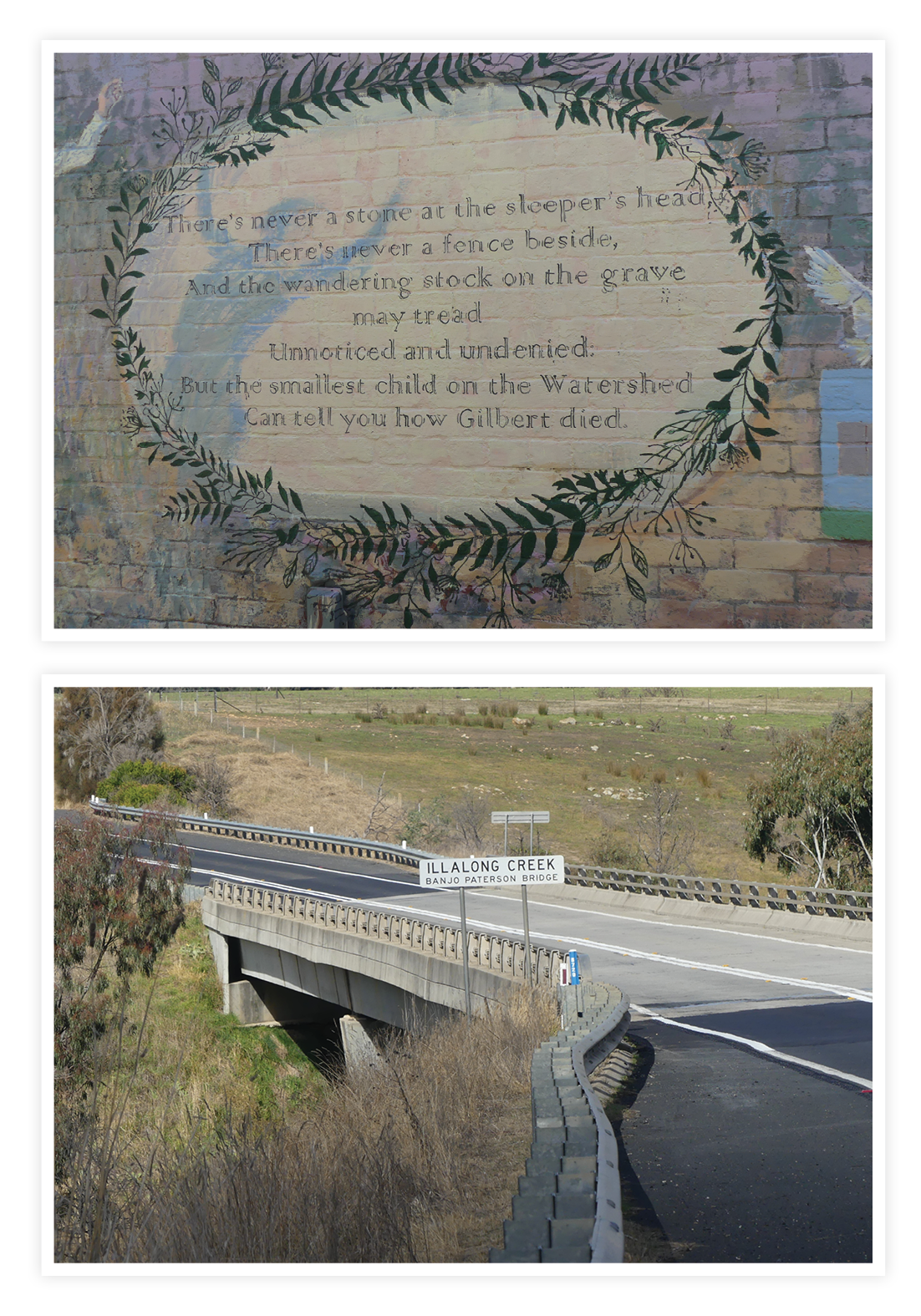
It is not surprising that Johnny Gilbert should feature in Banjo’s poetry and that Binalong has a Bushranger Walk. There is a bust of Andrew Barton Paterson in the town centre. Out of town there is the Paterson Bridge over Illalong Creek.
In Illalong Children Paterson records ‘Then the world, and civilisation, hit us with a bang. The great Southern Railway, connecting Sydney and Melbourne was built, right through the town, and for miles to the north and miles to the south were nothing but torn earth and navvies camps, and blasts going off, and the clang of temporary rails.’ The Railway as far as Albury was completed in 1878 and Paterson’s early childhood experiences of the work camps undoubtedly provided rich memories for an aspiring writer.
How Gilbert Died
‘There’s never a stone at the sleeper’s head,
There’s never a fence beside,
And the wandering stock on the grave may tread
Unnoticed and undenied,
But the smallest child on the Watershed
Can tell you how Gilbert died.
For he rode at dusk with his comrade Dunn
To the hut at the Stockman’s Ford;
In the waning light of the sinking sun
They peered with a fierce accord.
They were outlaws both — and on each man’s head
Was a thousand pounds reward.
They had taken toll of the country round,
And the troopers came behind
With a black that tracked like a human hound
In the scrub and the ranges blind:
He could run the trail where a white man’s eye
No sign of track could find.
He had hunted them out of the One Tree Hill
And over the Old Man Plain,
But they wheeled their tracks with a wild beast’s skill,
And they made for the range again.
Then away to the hut where their grandsire dwelt,
They rode with a loosened rein.
And their grandsire gave them a greeting bold:
‘Come in and rest in peace,
‘No safer place does the country hold —
‘With the night pursuit must cease,
‘And we’ll drink success to the roving boys,
‘And to hell with the black police.’
But they went to death when they entered there
In the hut at the Stockman’s Ford,
For their grandsire’s words were as false as fair —
They were doomed to the hangman’s cord.
He had sold them both to the black police
For the sake of the big reward.
In the depth of night there are forms that glide
As stealthily as serpents creep,
And around the hut where the outlaws hide
They plant in the shadows deep,
And they wait till the first faint flush of dawn
Shall waken their prey from sleep.
But Gilbert wakes while the night is dark —
A restless sleeper, aye,
He has heard the sound of a sheep-dog’s bark,
And his horse’s warning neigh,
And he says to his mate, ‘There are hawks abroad,
And it’s time that we went away.”
Their rifles stood at the stretcher head,
Their bridles lay to hand,
They wakened the old man out of his bed,
When they heard the sharp command:
‘In the name of the Queen lay down your arms,
‘Now, Dun and Gilbert, stand!’
Then Gilbert reached for his rifle true
That close at hand he kept,
He pointed straight at the voice and drew,
But never a flash outleapt,
For the water ran from the rifle breach —
It was drenched while the outlaws slept.
Then he dropped the piece with a bitter oath,
And he turned to his comrade Dunn:
“We are sold,” he said, “we are dead men both,
‘But there may be a chance for one;
‘I’ll stop and I’ll fight with the pistol here,
‘You take to your heels and run.”
So Dunn crept out on his hands and knees
In the dim, half-dawning light,
And he made his way to a patch of trees,
And vanished among the night,
And the trackers hunted his tracks all day,
But they never could trace his flight.
But Gilbert walked from the open door
In a confident style and rash;
He heard at his side the rifles roar,
And he heard the bullets crash.
But he laughed as he lifted his pistol-hand,
And he fired at the rifle-flash.
Then out of the shadows the troopers aimed
At his voice and the pistol sound,
With rifle flashes the darkness flamed,
He staggered and spun around,
And they riddled his body with rifle balls
As it lay on the blood-soaked ground.
There’s never a stone at the sleeper’s head,
There’s never a fence beside,
And the wandering stock on the grave may tread
Unnoticed and undenied,
But the smallest child on the Watershed
Can tell you how Gilbert died.
The Bulletin, 2 June 1894
Johnny Gilbert was shot by the police in 1865 and his grave is about 1km out of Binalong on the Harden Road. It is a heritage site on the Gold Trail between Young, Lambing Flat and Yass.
On 16 November 1864, a year before Johnny Gilbert died, he shot Police Sergeant Edmund Parry. Over 30 years later in 1895 Paterson immortalised Johnny Gilbert in his poem named for the bushranger and which is displayed in a mural in Binalong. Linking the Jugiong story to that of Binalong there is a memorial to Police Sergeant Parry in Jugiong.




Acknowledgements
The Upper Murray Historical Society wishes to acknowledge all of the above organisations for their support and thank the
National Library of Australia (NLA) together with
Mr Alistair Campbell for their assistance and their permission to use images from the
Papers of Andrew Barton ‘Banjo’ Paterson (MS 10483), NLA. For more information
click here.
History brought to life by
CalvertandCo.com
© Copyright protected 2026, Calvert & Co, Honor Auchinleck, and The Man From Snowy River Museum. All rights reserved.