
The Banjo Paterson High Country Trail
Albury
Albury
Paterson didn’t write a poem mentioning Albury and there are no monuments to the Bard in the city. For all that, Paterson had a connection. In Paterson’s album (in the NLA’s A B Paterson Papers) he has captioned a pair of photographs ‘Bullock Team Albury’.
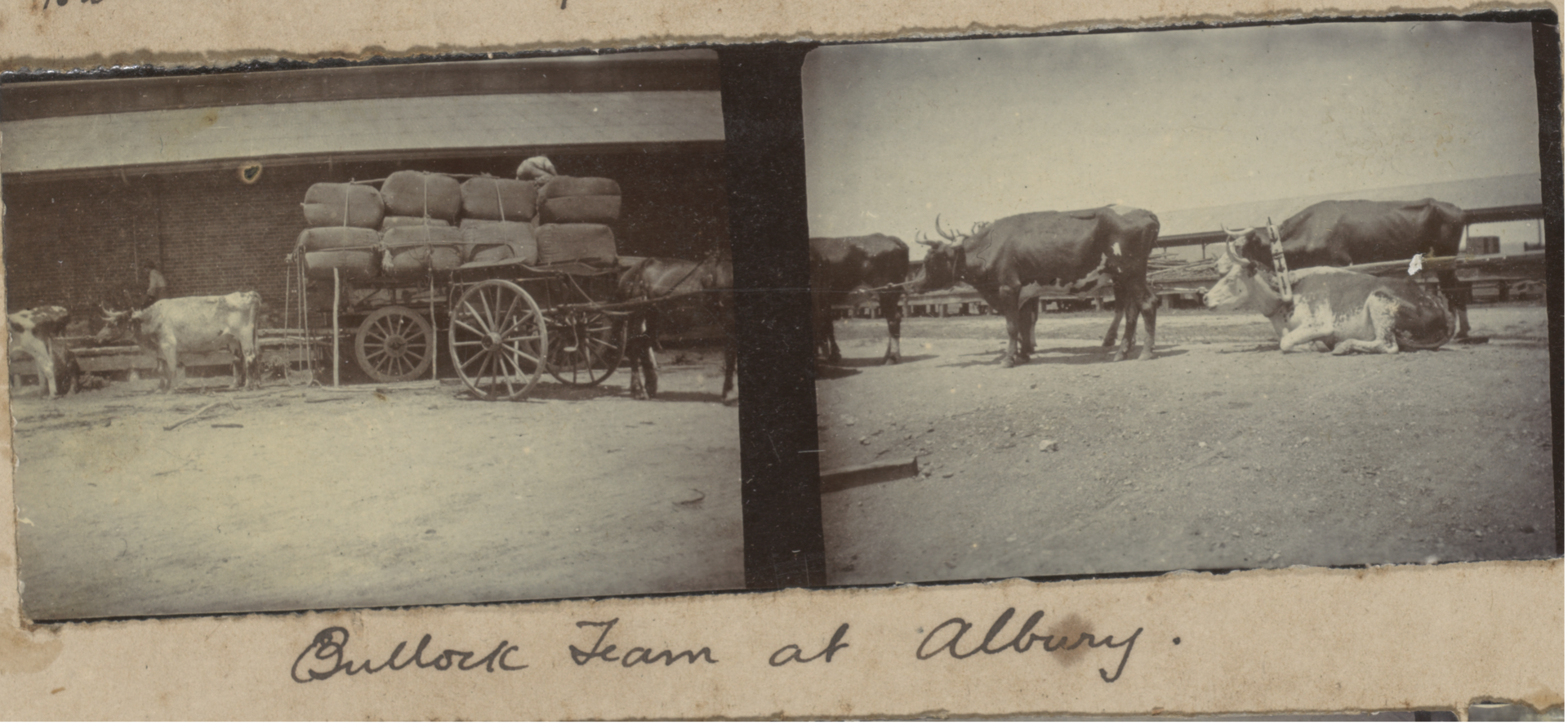
From the Album of A B Paterson (Source The Papers of Andrew Barton Paterson, 1807 - 1950 NLA MS10483/10/30/38)
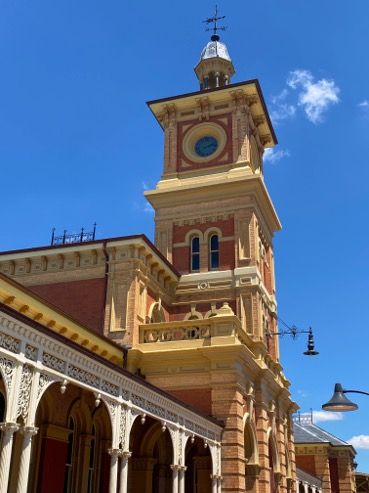
These photographs suggest Paterson might have witnessed bullock teams bringing in bales for wool for loading onto the trains at Albury Railway station. The sidings and the platform are visible in the pictures. Completed in 1882, it is likely that Paterson took the train from Sydney to Albury Railway station before continuing his journey from Wodonga to Tallangatta by train.
The Sydney Morning Herald (20 October 1900) reported about Albury, ‘Mr Paterson, the special war correspondent of the “Sydney Morning Herald,” lectured here tonight and met with a good reception from a large audience.’ On 26 October 1900 The Albury Banner and Wodonga Express, gives a fuller account of Paterson’s lecture entitled ‘Australians in Action’. Notably, the account concludes on a humanitarian note with a reference to ‘Trooper Fleming building a kind of wall for the protection of a wounded comrade, under fire’ being ‘a signal for a very warm demonstration of approval.’
https://trove.nla.gov.au/newspaper/article/99844519/10847905
A week later on Friday 26 October 1900 on page 2 the Wodonga and Towong Sentinel reported ‘the citizens of Wodonga were however far less impressed. To the surprise of his erstwhile admirers, “Banjo” confined himself to recounting the wonderful achievements of the New South Wales contingents and not a word was said about the Victorian contingents.’
https://trove.nla.gov.au/newspaper/article/998444519

Acknowledgements
The Upper Murray Historical Society wishes to acknowledge all of the above organisations for their support and thank the
National Library of Australia (NLA) together with
Mr Alistair Campbell for their assistance and their permission to use images from the
Papers of Andrew Barton ‘Banjo’ Paterson (MS 10483), NLA. For more information
click here.
History brought to life by
CalvertandCo.com
© Copyright protected 2026, Calvert & Co, Honor Auchinleck, and The Man From Snowy River Museum. All rights reserved.