
The Banjo Paterson High Country Trail
Bowning and Yass
Bowning
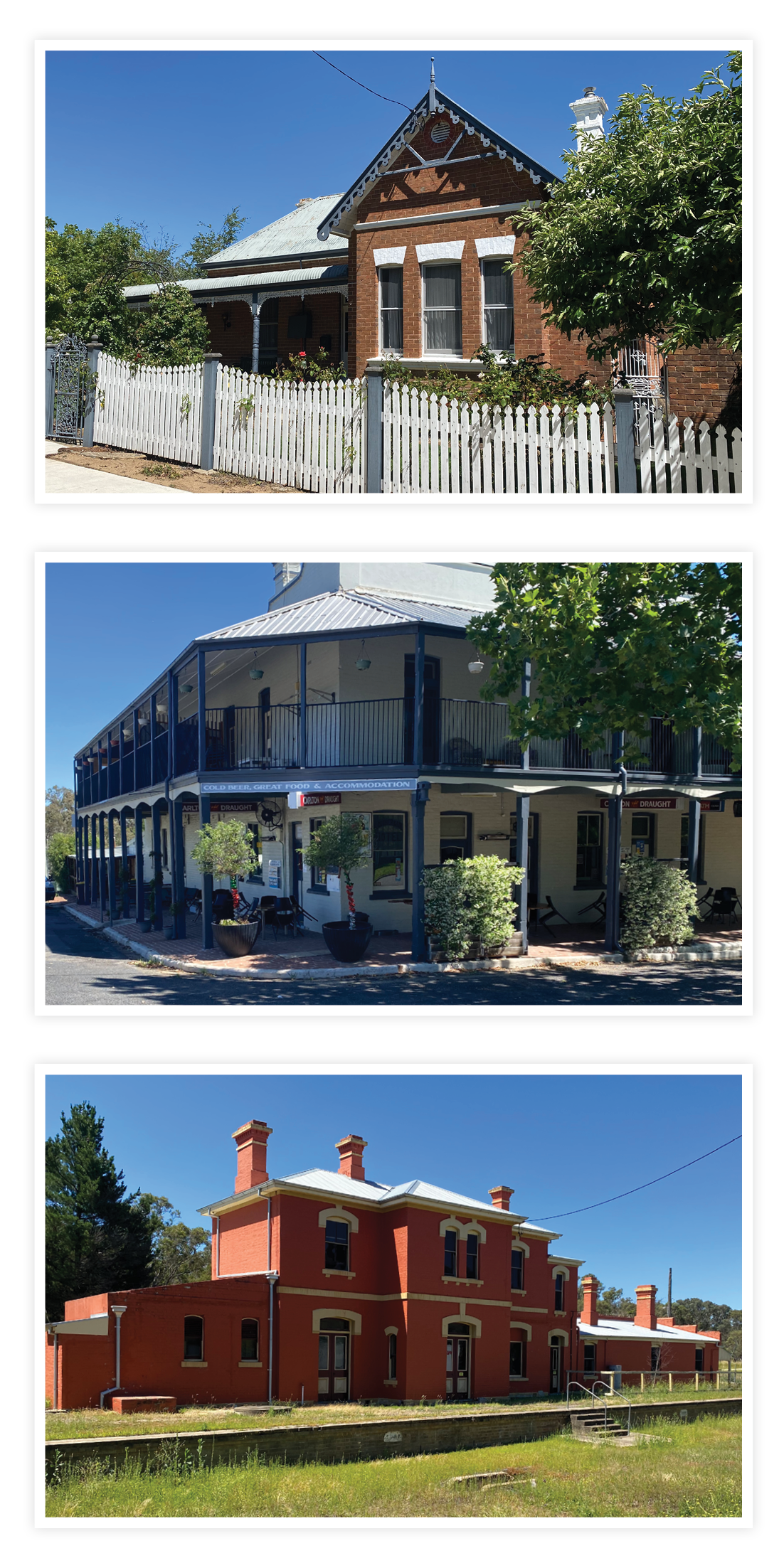
Bowning lies just over 27km from Bookham and about 14km from Yass. The Bowning pub Mayfield House is supposed to be where Paterson debated the merits of living in the bush with contemporary poet Henry Lawson. Lawson had a family connection through his aunt Phoebe and her husband Richard who lived at Mayfield House.
Lawson opened the exchange in the first line of his poem ‘Up the Country’ on 8 July 1892 in The Bulletin when he wrote, ‘I am back from up the country—very sorry that I went—. Later that month on 23 July Paterson retorted in the final lines of ‘In Defence of the Bush’ with the words ‘For the bush will never suit you and you’ll never suit the bush.’
Paterson told the story of how the debate developed. It all began during an interview in the office of Jules François Archibald, Editor of the Bulletin when J F Archibald asked, ‘did I know anything about the bush. I told him I had been reared there.’
“All right”, he said, “have a go at the bush… Let’s see what you can do”
‘And that is how I came to meet Henry Lawson.’
‘Henry Lawson, ‘suggested that we should write against each other, he putting the bush from his point of view, and I putting it from mine'.
Although other poets joined in the debate, it was not tainted by ill feeling and Paterson is reputed to have helped Lawson through some legal problems. Both Lawson and Paterson have their own distinguished places in Australian poetry.
As a pub with large verandahs and balconies is next door to Mayfield House, one wonders if the two poets shared a drink together. Did one or other of the poets travel to Bowning by train? Bowning has a disused, heritage listed railway station.
In Defence of the Bush
In Defence of the Bush
So you’re back from up the country, Mister Lawson, where you went,
And you’re cursing all the business in a bitter discontent;
Well, we grieve to disappoint you, and it makes us sad to hear
That it wasn’t cool and shady — and there wasn’t plenty beer,
And the loony bullock snorted when you first came into view;
Well, you know it’s not so often that he sees a swell like you;
And the roads were hot and dusty, and the plains were burnt and brown,
And no doubt you’re better suited drinking lemon-squash in town.
Yet, perchance, if you should journey down the very track you went
In a month or two at furthest you would wonder what it meant,
Where the sunbaked earth was gasping like a creature in its pain
You would find the grasses waving like a field of summer grain,
And the miles of thirsty gutters blocked with sand and choked with mud,
You would find them mighty rivers with a turbid, sweeping flood;
For the rain and drought and sunshine make no changes in the street,
In the sullen line of buildings and the ceaseless tramp of feet;
But the bush hath moods and changes, as the seasons rise and fall,
And the men who know the bushland — they are loyal through it all.
****
But you found the bush was dismal and a land of no delight,
Did you chance to hear a chorus in the shearers’ huts at night?
Did they “rise up, William Riley” by the camp-fire’s cheery blaze?
Did they rise him as we rose him in the good old droving days?
And the women of the homesteads and the men you chanced to meet —
Were their faces sour and saddened like the “faces in the street”,
And the “shy selector children” — were they better now or worse
Than the little city urchins who would greet you with a curse?
Is not such a life much better than the squalid street and square
Where the fallen women flaunt it in the fierce electric glare,
Where the sempstress plies her sewing till her eyes are sore and red
In a filthy, dirty attic toiling on for daily bread?
Did you hear no sweeter voices in the music of the bush
Than the roar of trams and buses, and the warwhoop of “the push”?
Did the magpies rouse your slumbers with their carol sweet and strange?
Did you hear the silver chiming of the bellbirds on the range?
But, perchance, the wild birds’ music by your senses was despised,
For you say you’ll stay in townships till the bush is civilised.
Would you make it a tea-garden and on Sundays have a band
Where the “blokes” might take their “donahs”, with a “public” close at hand?
You had better stick to Sydney and make merry with the “push”,
For the bush will never suit you, and you’ll never suit the bush.
The Bulletin, 1892
Yass
As Yass is only 34km or 26 miles from Binalong and Ilalong where Paterson lived as a child and only 55km or 34 miles from Coodravale and Wee Jasper where he farmed between 1908 and 1911, Yass was Paterson’s main town.
Paterson also visited Yass in 1905 with J M Arnott during the Dunlop Reliability Trail. On 24 February in the Evening News Paterson wrote, ‘Yass was full of people,’ and ‘had a lovely road for eight miles or so.’
https://trove.nla.gov.au/newspaper/article/112752255
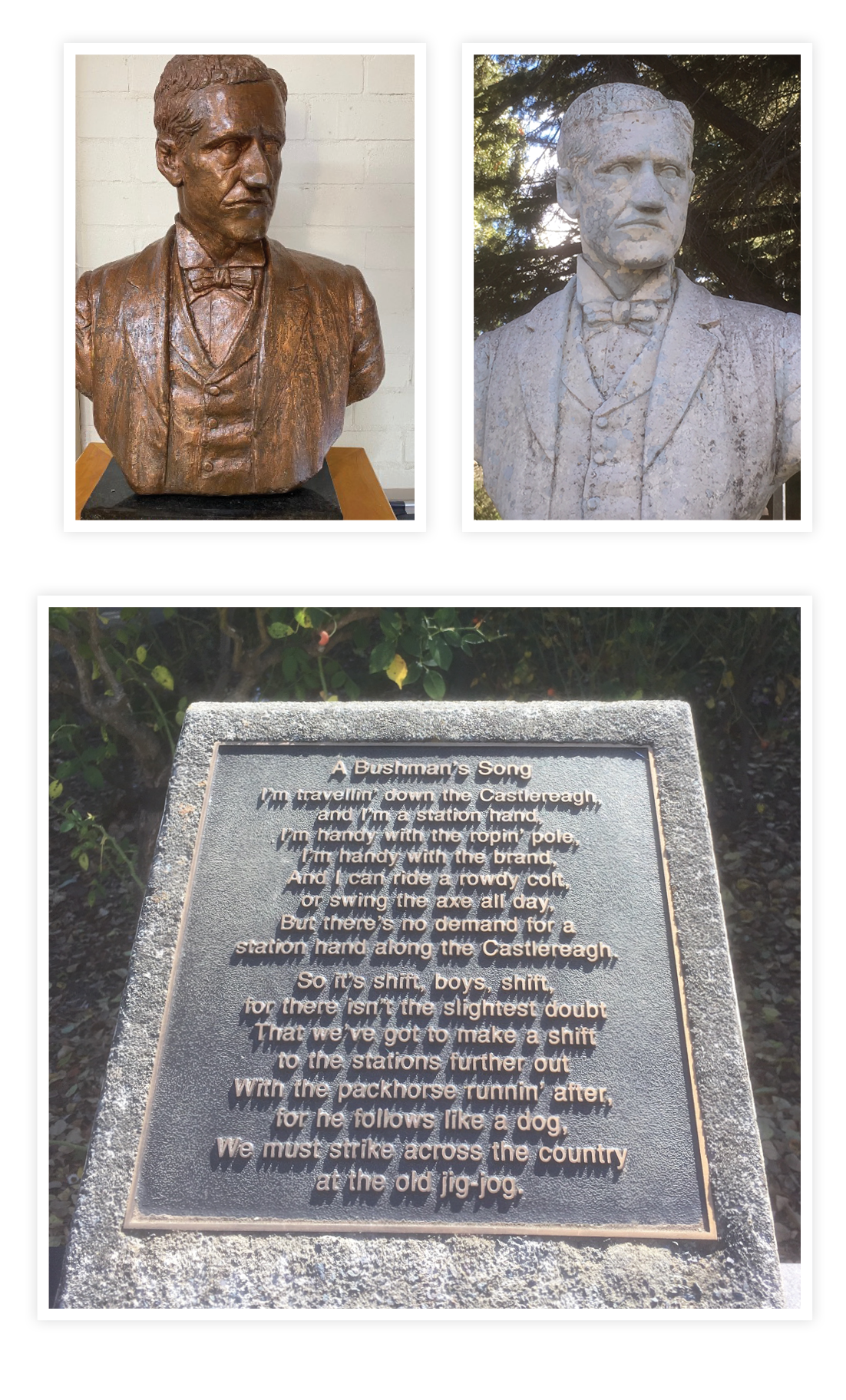
In the Banjo Paterson Park in Meehan Street, there is a replica of Mrs Folks' bust of Banjo Paterson. On either side of the Park's main entrance are concrete posts into which are set plaques with verses of some of Paterson's best-loved poems. The Yass Valley Information Centre has an informative brochure about Banjo Paterson.
In the heritage rich Yass Valley the Banjo Paterson High Country Trail meets explorers Hume and Hovell Track in Yass where the Hume and Hovell Track begins at Cooma Cottage. Both Trail and Track continue along the Yass Valley to Wee Jasper before heading south towards to Tumut and Snowy Valleys. It is not lost on Paterson enthusiasts that the Bard pays tribute to the explorers in his poem ‘The Pioneers’. Perhaps Paterson was also thinking of his father Andrew Bogle Paterson who was born at Crofton Hill, Lanark in Scotland and was in every sense a pioneer who lived tough life, battling the vagaries of the season while turning wild country into farmland and serving his community as a magistrate.
The Pioneers
The Pioneers
They came of bold and roving stock that would not fixed abide;
They were the sons of field and flock since e'er they learnt to ride,
We may not hope to see such men in these degenerate years
As those explorers of the bush – the brave old pioneers.
'Twas they who rode the trackless bush in heat and storm and drought; 'Twas they that heard the master-word that called them farther out; 'Twas they who followed up the trail the mountain cattle made,
And pressed across the mighty range where now their bones are laid.
But now the times are dull and slow, the brave old days are dead
When hardy bushmen started out, and forced their way ahead
By tangled scrub and forests grim towards the unknown west,
And spied the far-off promised land from off the range's crest.
Oh! Ye, that sleep in lonely graves by far-off ridge and plain,
We drink to you in silence now as Christmas comes again,
The men who fought the wilderness through rough unsettled years –
The founders of our nation's life, the brave old pioneers.
The Town and Country Journal, 19 December 1896.

Acknowledgements
The Upper Murray Historical Society wishes to acknowledge all of the above organisations for their support and thank the
National Library of Australia (NLA) together with
Mr Alistair Campbell for their assistance and their permission to use images from the
Papers of Andrew Barton ‘Banjo’ Paterson (MS 10483), NLA. For more information
click here.
History brought to life by
CalvertandCo.com
© Copyright protected 2026, Calvert & Co, Honor Auchinleck, and The Man From Snowy River Museum. All rights reserved.