
The Banjo Paterson High Country Trail
Cooma
Cooma
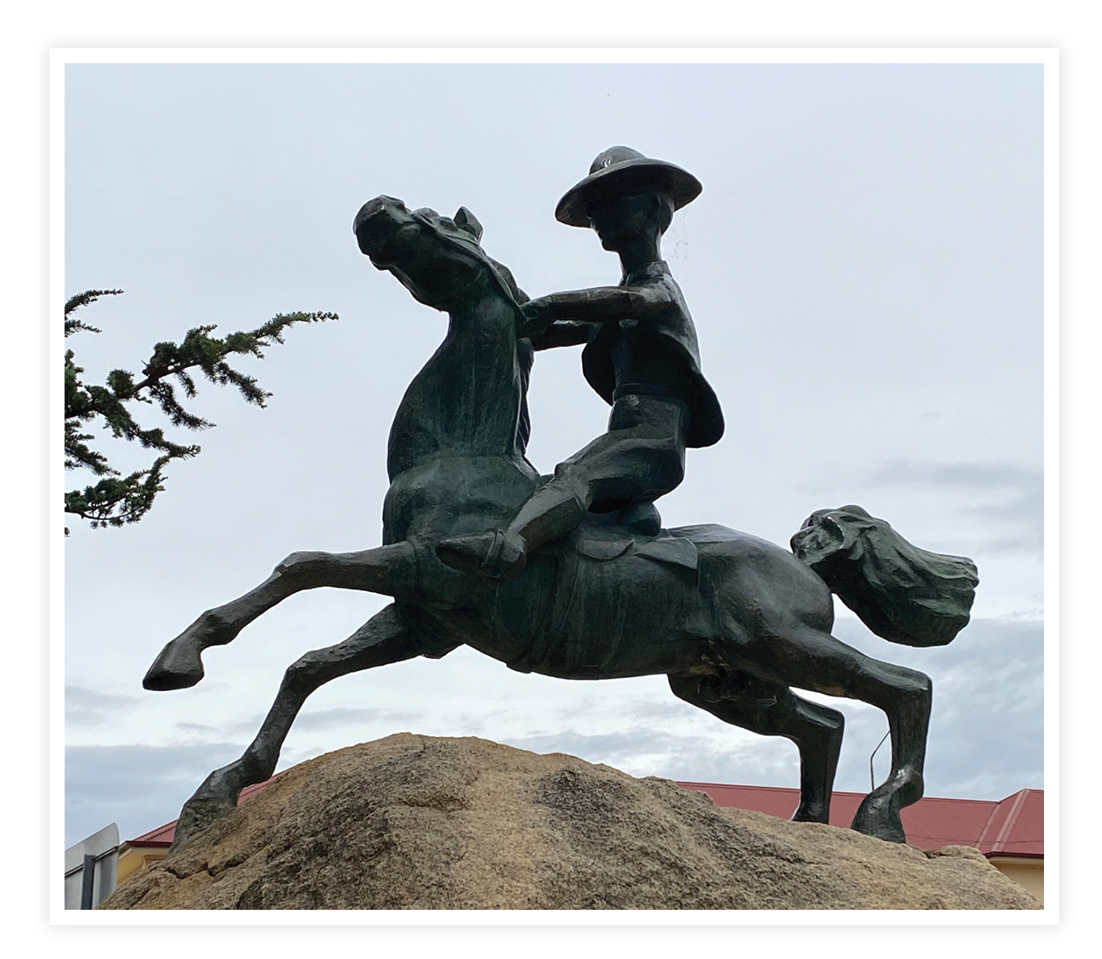
All the action of ‘The Man from Snowy River’ is captured by Ian McKay in his exquisite little equestrian sculpture located in Centennial Park, Sharp Street Cooma. Yet Paterson is better remembered in Cooma for some of his other poetry.
The most direct reference to Cooma in Paterson’s poetry is in the second verse of the poem:
Shearing at Castlereagh
‘The man that “rung” the Tubbo shed is not the ringer here,
That stripling from the Cooma-side can teach him how to shear.
They trim away the ragged locks, and rip the cutter goes
And leaves a track of snowy fleece from brisket to the nose,
It’s lovely how they peel it off with never stop nor stay,
They’re racing for the ringer’s place this year at Castlereagh.’
Shearing at Castlereagh
Shearing at Castlereagh
The bell is set a-ringing, and the engine gives a toot,
There's five-and-thirty shearers here are shearing for the loot,
So stir yourselves, you penners-up, and shove the sheep along,
The musterers are fetching them a hundred thousand strong,
And make your collie dogs speak up - what would the buyers say
In London if the wool was late this year from Castlereagh?
The man that "rung" the Tubbo shed is not the ringer here,
That stripling from the Cooma side can teach him how to shear.
They trim away the ragged locks, and rip the cutter goes,
And leaves a track of snowy fleece from brisket to the nose;
It's lovely how they peel it off with never stop nor stay,
They're racing for the ringer's place this year at Castlereagh.
The man that keeps the cutters sharp is growling in his cage,
He's always in a hurry and he's always in a rage —
"You clumsy-fisted muttonheads, you'd turn a fellow sick,
You pass yourselves as shearers, you were born to swing a pick.
Another broken cutter here, that's two you've broke today,
It's awful how such crawlers come to shear at Castlereagh."
The youngsters picking up the fleece enjoy the merry din,
They throw the classer up the fleece, he throws it to the bin;
The pressers standing by the rack are waiting for the wool,
There's room for just a couple more, the press is nearly full;
Now jump upon the lever, lads, and heave and heave away,
Another bale of golden fleece is branded "Castlereagh".
Queanbeyan Age, 9 November 1895
The Shearer
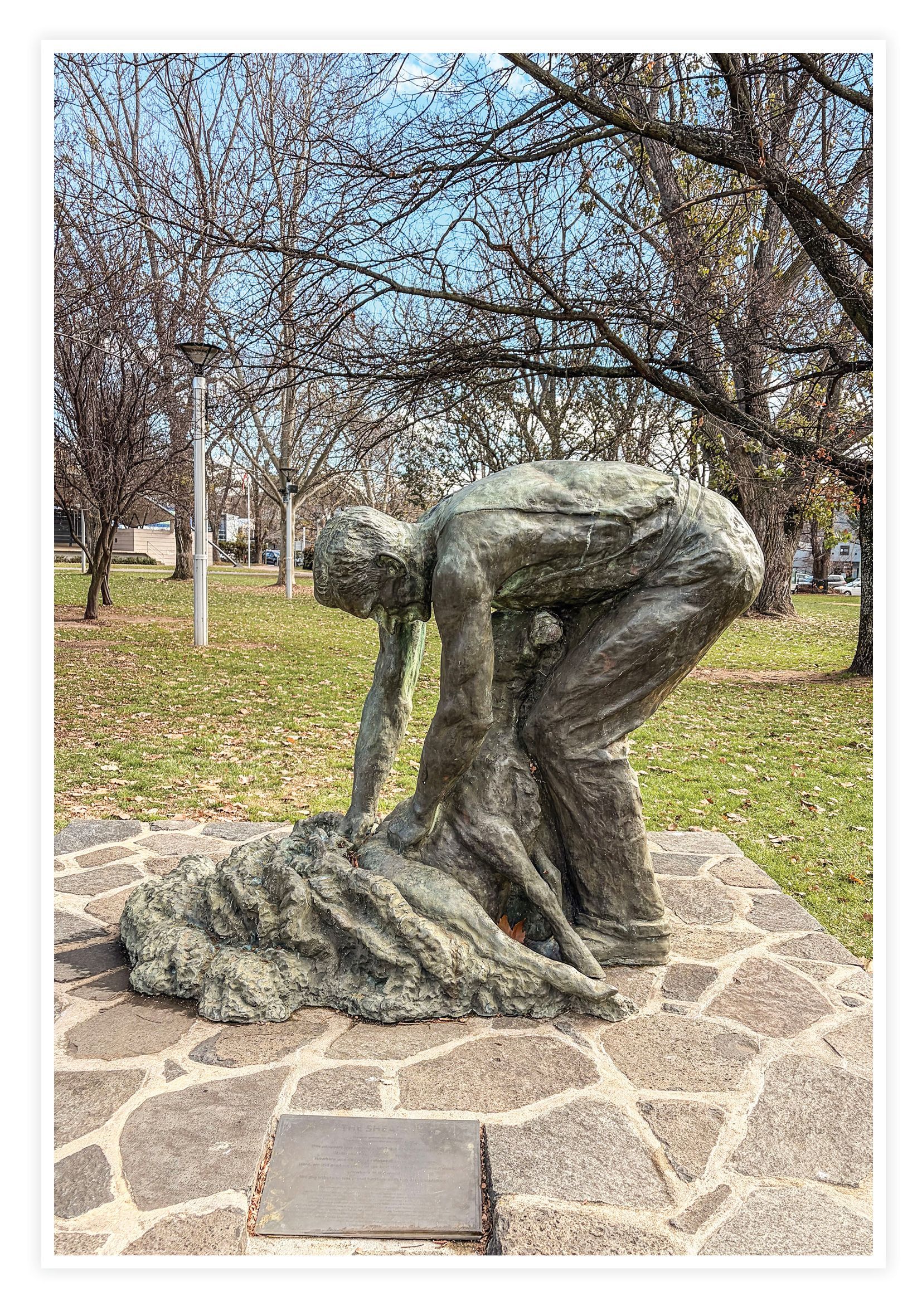
Fifty-six years after Banjo Paterson published his poem Shearing at Castlereagh, a talented young sculptor Rix Wright highlighted in his bronze figure of The Shearer the role of the wool industry in the Monaro and in Australian history. The plaque on the sculpture's plinth reads 'This sculpture was created in 1950 at a time when it was said Australia 'Rode on a sheep's back'.
Ten yeas after Rix Wright died, his children Bronwyn and Bruno unveiled the sculpture on 17 September 2019 in Centennial Park, (on the corner of Bombala and Sharp Streets) in Cooma.
Rix Wright was born in 1930 on his family's property 'Knockalong' near the Monaro town of Delegate. His mother was the internationally known artist Hilda Nicholas Wright. Like poet Banjo Paterson, artists, Hilda Rix Nicholas mother and son Rix's work is a celebration of Australian landscape, character and way of life.
The Geebung Polo Club
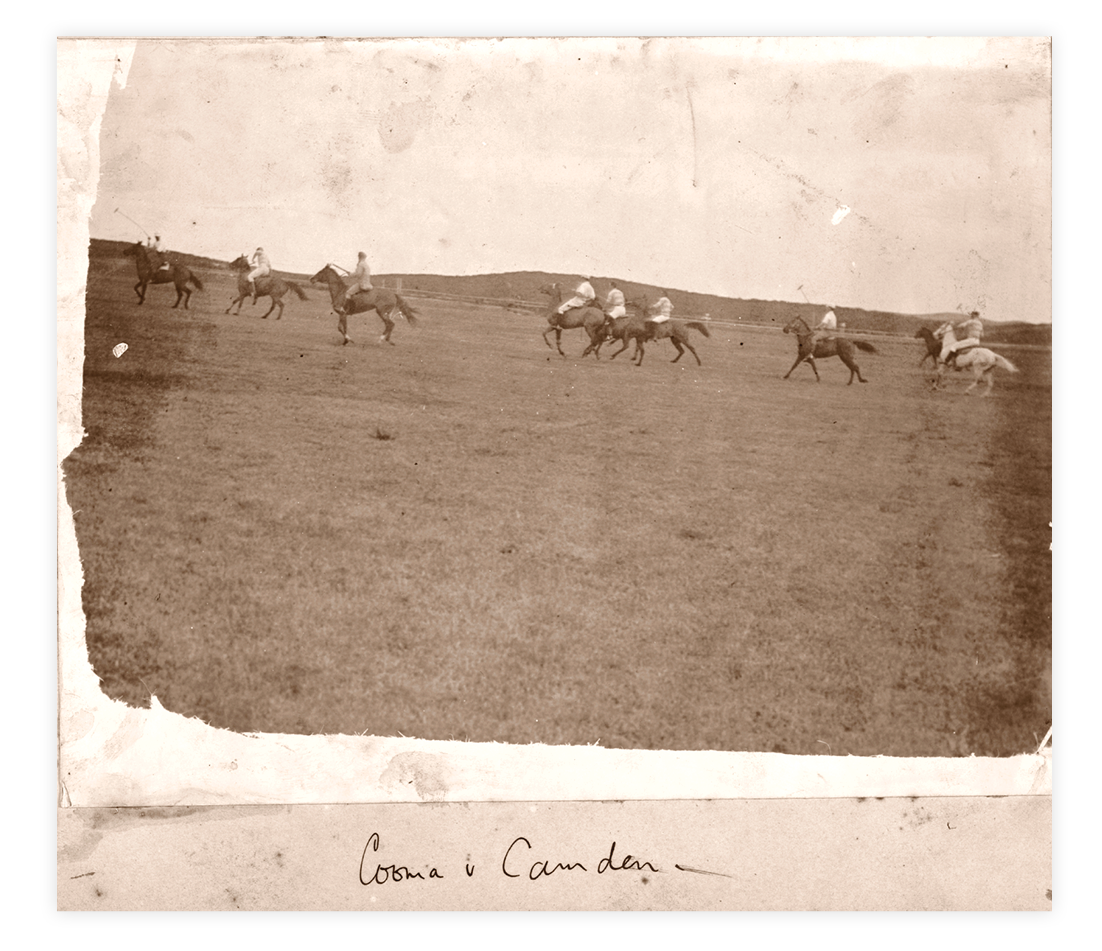
The Geebung Polo Club might have been the Cooma Polo Club and the Cuff and Collar team might have come from Camden? Or, was it the Cooma and Camperdown teams? Paterson photographed Cooma playing both Camden and Camperdown. He seemed to throw his readers off the scent by suggesting that they were buried ‘By the old Campaspe River, where the breezes shake the grass, …' But Paterson didn’t let distance stand in the way of his inspiration! Paterson told his own story.
In 1939 Paterson wrote about the Geebung Polo Club Paterson wrote, ‘We played a match against the Cooma Team, real wild men with cabbage-tree hats, and skin tight pants, their hats held on by a strap under their noses. I must have had the gift of prophesy because, before we went up, I wrote a jingle called ‘The Geebung Polo Club…’
Cooma knows how it was and the town has a Geebung Street and the Geebungs or the Cooma Polo Club played Camden’s ‘Cuff and Collar’ team on Polo Flat. Paterson is said to have recited his poem ‘The Geebung Polo Club’ in the Prince of Wales Hotel in Sharp Street. Another Cooma resident tells of how a great granddad shared damper with Paterson while they were enjoying a campfire. Paterson is reputed to part of line of literary figures including poet Barcroft Boake and Patrick White to have spent time at Bolaro. Stories must abound and it is time to tell them!
The Geebung Polo Club
The Geebung Polo Club
It was somewhere up the country, in a land of rock and scrub,
That they formed an institution called the Geebung Polo Club.
They were long and wiry natives from the rugged mountainside,
And the horse was never saddled that the Geebungs couldn’t ride;
But their style of playing polo was irregular and rash –
They had mighty little science, but a mighty lot of dash;
And they played on mountain ponies that we’re muscular and strong,
Though their coats were quite unpolished, and their manes and tails
were long
And they used to train those ponies wheeling cattle in the scrub;
They were demons, were the members of the Geebung Polo Club.
It was somewhere down the country, in the city’s smoke and steam,
That a polo club existed, called the Cuff and Collar Team.
As a social institution ‘twas a marvellous success,
For the members were distinguished by exclusiveness and dress.
They had natty little ponies that were nice, and smooth, and sleek,
For their cultivated owners only rode ‘em once a week.
So they started up the country in pursuit of sport and fame,
For they meant to show the Geebungs how they ought to play the game;
And they took their valets with them – just to give their boots a rub
Ere they started operations on the Geebung Polo Club.’
Now my readers can imagine how the contest ebbed and flowed,
When the Geebung boys got going it was time to clear the road;
And the game was so terrific that ere half the time was gone
A spectator's leg was broken — just from merely looking on.
For they waddied one another till the plain was strewn with dead,
While the score was kept so even that they neither got ahead.
And the Cuff and Collar Captain, when he tumbled off to die,
Was the last surviving player — so the game was called a tie.
Then the Captain of the Geebungs raised him slowly from the ground,
Though his wounds were mostly mortal, yet he fiercely gazed around;
There was no one to oppose him — all the rest were in a trance,
So he scrambled on his pony for his last expiring chance,
For he meant to make an effort to get victory to his side;
So he struck at goal — and missed it — then he tumbled off and died.
****
By the old Campaspe River, where the breezes shake the grass,
There's a row of little gravestones that the stockmen never pass,
For they bear a crude inscription saying, `Stranger, drop a tear,
For the Cuff and Collar players and the Geebung boys lie here.'
And on misty moonlit evenings, while the dingoes howl around,
You can see their shadows flitting down that phantom polo ground;
You can hear the loud collisions as the flying players meet,
And the rattle of the mallets, and the rush of ponies' feet,
Till the terrified spectator rides like blazes to the pub —
He's been haunted by the spectres of the Geebung Polo Club.
The Antipodean, 14 December 1893
(The Antipodean was an annual literary journal, first published in 1892).
Banjo Paterson must have had an affection for the Monaro.
In his poem The Open Steeplechase he wrote:
“Make the running,” said the trainer, “it’s your only chance whatever,
Make it hot from start to finish, for the old black horse can stay,
And just think of how they’ll take it, when they hear on Snowy River
That the country boy was plucky, and the country horse was clever,
You must ride for old Monaro and the mountain boys today.”
The Bulletin, 1891
Monaro and its largest town Cooma go almost hand in hand and in his poem ‘At the Melting of the Snow’ Banjo Paterson mentions Monaro:
At the Melting of the Snow
At the Melting of the Snow
There’s a sunny Southern land,
And it’s there that I would be
Where the big hills stand
In the South Countrie!
When the wattles bloom again
Then it’s time for us to go
To the old Monaro country
At the melting of the snow.
To the East or to the West,
Or wherever you may be,
You will find no place
Like the South Countrie.
For the skies are blue above,
And the grass is green below,
In the old Monaro country
At the melting of the snow.
Now the team is in the plough,
And the thrushes start to sing,
And the pigeons on the bough
Are rejoicing at the Spring.
So come my comrades all,
Let us saddle up and go
To the old Monaro country
At the melting of the snow.
A B Paterson’s book Saltbush Bill J.P. 1917




Acknowledgements
The Upper Murray Historical Society wishes to acknowledge all of the above organisations for their support and thank the
National Library of Australia (NLA) together with
Mr Alistair Campbell for their assistance and their permission to use images from the
Papers of Andrew Barton ‘Banjo’ Paterson (MS 10483), NLA. For more information
click here.
History brought to life by
CalvertandCo.com
© Copyright protected 2026, Calvert & Co, Honor Auchinleck, and The Man From Snowy River Museum. All rights reserved.