
The Banjo Paterson High Country Trail
Corryong and the Upper Murray
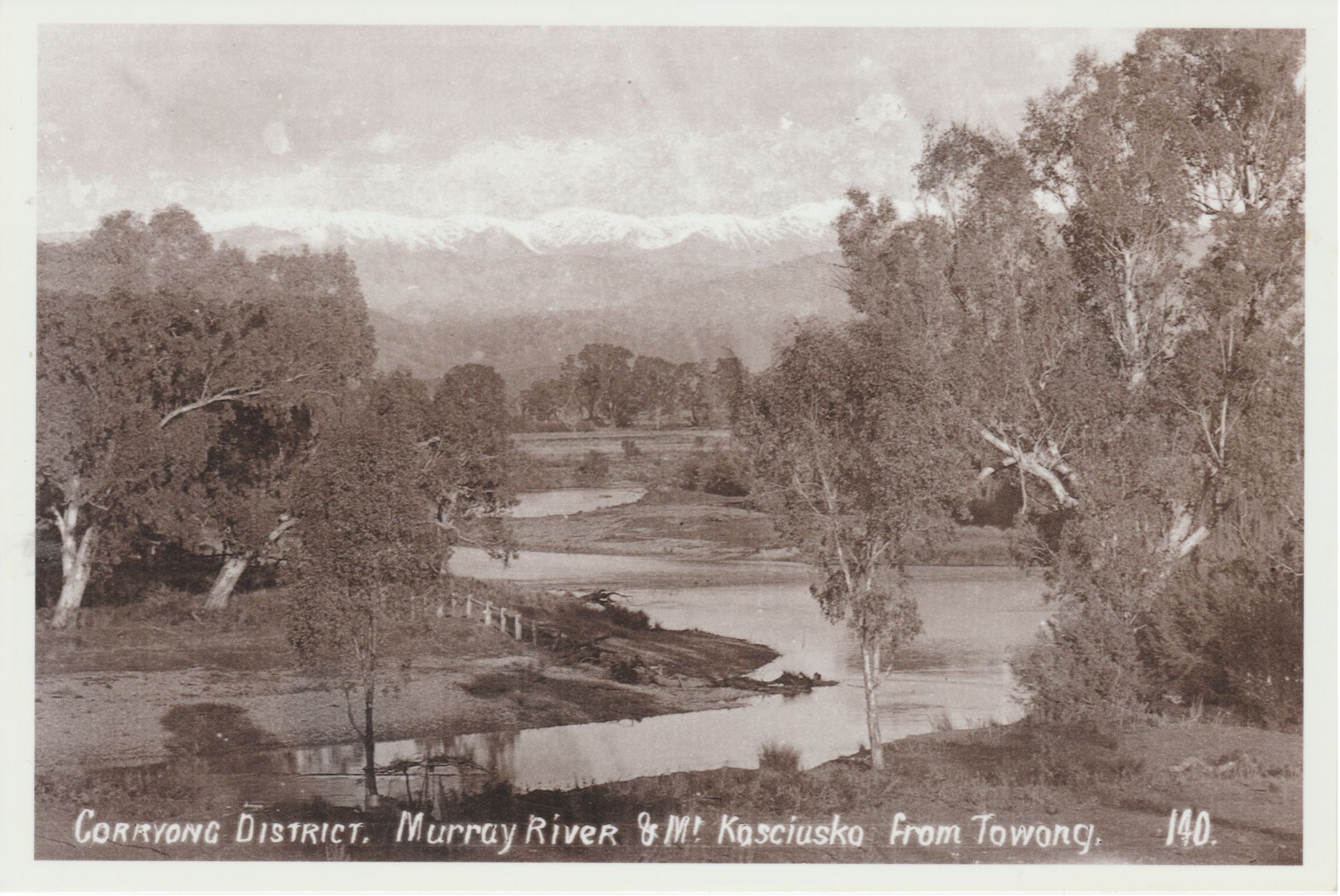
Photograph by Arnold Playle (Source, the Auchinleck family collection and reproduced with the permission of John Whitehead)
Corryong and the Upper Murray
Upper Murray photographer Arnold Playle’s caption below his photograph of the Main Range taken from the Upper Murray seems to imply that the name ‘Kosciusko’ included the entire High Country area.
Corryong has a number of memorials to Banjo Paterson and the Man from Snowy River. A Brett Garling sculpture of ‘The Man from Snowy River’ stands outside the Visitor Information Centre. ‘The Man from Snowy River Bush Festival’ is held each year in April. And outside the Soldiers’ Memorial Hall in Donaldson Street there is the mural ‘The Men and Their Mounts’.
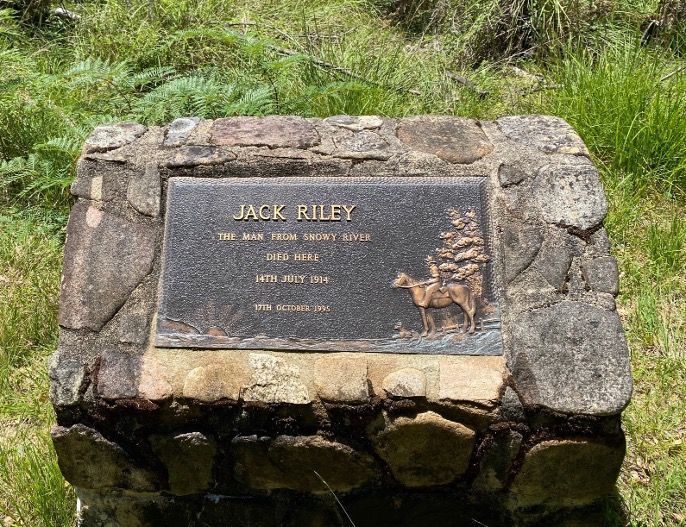
‘The Man from Snowy River’, Jack (Johnny) Riley is buried in Corryong’s Pioneer Cemetery. A storyboard at the Pioneer Cemetery tells Jack Riley’s story. No journey following the life of Jack Riley would be complete without following the trail of his last journey from his ‘homestead’ as described by Paterson in his photograph caption to the site of the hut near the junction of the Indi River and Surveyor’s Creek where there is a plaque marking the place where the hut once stood and where Jack Riley died on 14 July 1914.
Many of the most evocative memorials lie in the stories told and recorded in writing. Tom recounted how his Uncle Jack Mitchell at Khancoban Station used to send Jack a bottle of whisky with anyone who was going out to Tom Groggin. Jack knew of course, that Jack Riley would give the bearer of gift a great welcome. When I was a child Tom loved telling the story as he remembered his father telling it: “See ‘ere now, I’m not one of them boozers, I likes it little and often.” The truth Tom explained, was that Jack Riley liked it little and very often. By morning the bottle would be empty and Jack would say to his guest, “See ‘ere now, he says, it’s time youse was going,” and with that he turn out his guest and hunted him away!
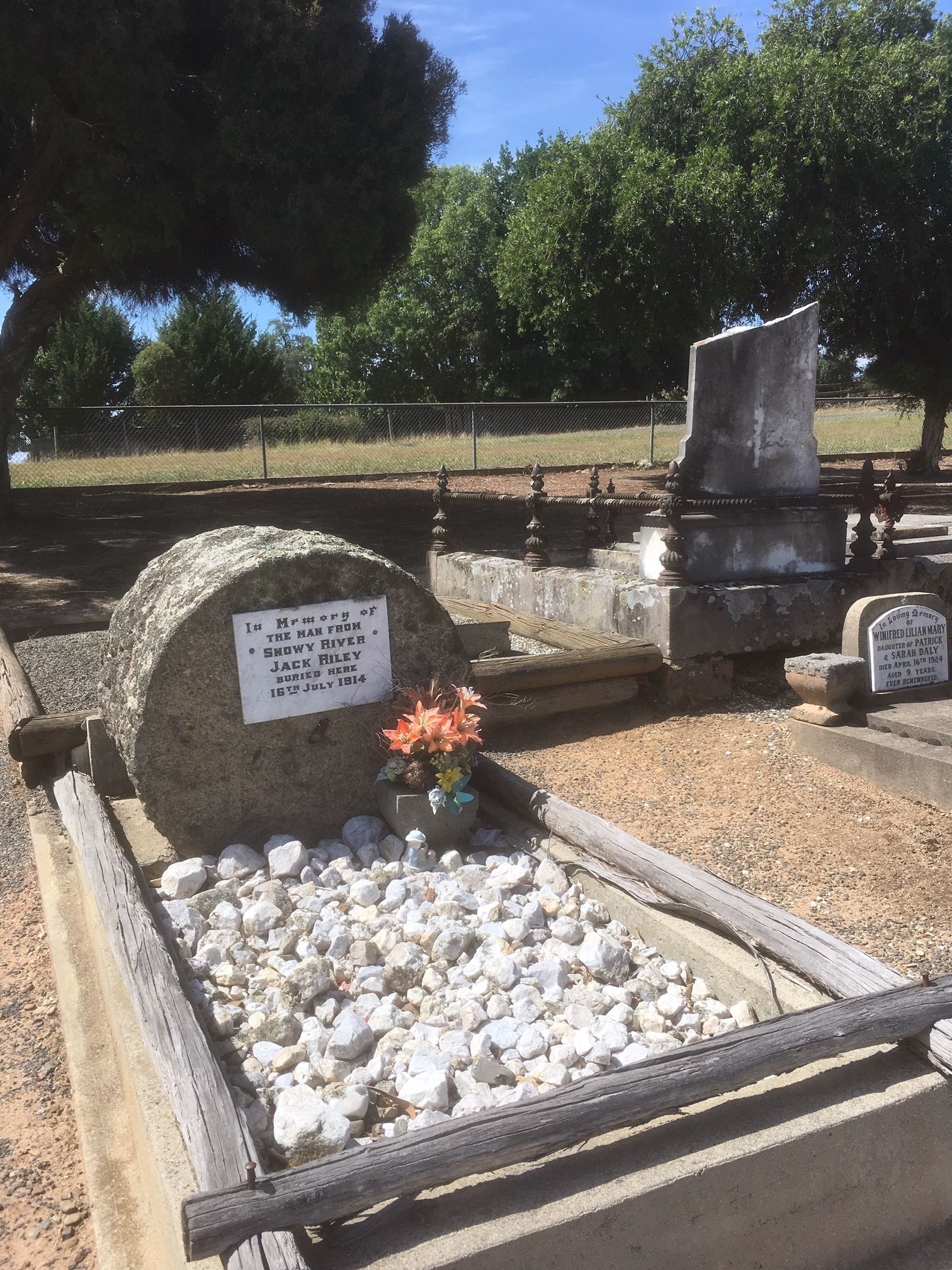
After Tom Mitchell returned from the Second World War in late 1945, he interviewed those who remembered Jack Riley and wrote the story he was told about Jack’s final journey:
Jack Riley’s end was sad, especially when you think of the picture painted by Banjo Paterson of the ‘stripling on the small and weedy beast.’
“He’d been pretty sick once before,” Mr Findlay said, “and had been away with that disease where your legs all swell up, you know, dropsy…but he was cured and had come back to his hut in Groggin. I was out there mustering cattle all round those hills with three other men and I called in to see old Jack and found him pretty bad. I said we would take him into Corryong to the doctor but he said no he’d rather stay there, so we left him, and went on with the mustering, but a few days later we looked in again and here is the poor old fellow lying on the floor just about at the end of his tether. So we knocked together a bit of a stretcher out of a couple of saplings and some hessian that was kicking round the hut and we set off to carry him in to the doctor..."
‘It must have been one hell of a journey along that hair raising track chipped along the slippery cliffs above the raging waters of the Indi tearing through the narrow defile of the Murray Gates formed by a great ridge of Mt Pinnabar on the Victorian side, and a series of almost vertical spurs coming down from the Granuaille Mountain on the New South Wales side. The men carrying the tiny shrunken form on the home-made stretcher slipped and stumbled and sent stones bounding and flying off into the misty depths below. The stretcher lurched and heaved. Jack Riley, his spirit hovering between this world and the one just a little beyond us all the time, all silent, or shouted sporadic bursts or words mingled with queer sounds. Snatches of song, strange names, imprecations, sighs, terms of endearment, yells of encouragement or warning to unseen men, came tumbling forth, sometimes with startling clarity, sometimes jumbled together, sometimes just a babble of incoherencies. It was cruel work on the carriers, but their only thought was for Jack Riley. At Hermit’s Creek they offered him a drink of his beloved whisky, but to their surprise he refused saying he could not swallow it. “Cripes, he must be crook,” someone remarked. The Hermit’s Hill was too steep for the party however much they tried, and it was decided to get Jack Riley onto a horse. Bob Butler was the smallest and lightest of the party and he jumped up onto the quietest of the horses and poor old Jack was lifted up into the saddle. Bob held him there with his arms round the thin waist. The horse, panting and straining, was led and flogged inch by inch up the mountain. At the top, reached after an eternity of doubt and struggle, the weather was blowing a bitter gale with flurries of snow coming stinging through the straining trunks of the forest. The trees roared back to the gale that tore limbs whole-sale from them. Jack Riley, his spirit hovering between this world and the one just a little beyond us, lay silent or shouted queer sounds. At the top of the climb where the stones displaced by the horses hoofs bounded off into misty space and then vanished in the depths below, Jack Riley’s head slumped and they thought he was gone but he rallied as they began to pick their way down the steep descent to the Hermit’s Creek.
“If we can get him to the hut at Surveyor’s Creek, we can get him into a bunk and warm and he will be right,” said Bob.
The hut was reached and Jack released from Bob’s cramped arms. Jack was carried into the hut and gently laid on the rough bunk and sticks were snapped and a fire got going.
“Now he’ll be O.K.,” someone said, but as the flames leapt up the chimney, they took the spirit of the Man from Snowy River with them.
“And down by Kosciusko, where the pine-clad ridges raise
Their torn and ragged battlements on high. ....’
To follow the route of Jack Riley’s final journey is to follow a story of bush humanitarianism and of mateship before ever the expression was coined in the First World War. To see the steep terrain over which the ailing Jack was carried, part on a stretcher and part on the front of Bob Butler’s saddle is to go to the heart of bush humanitarianism and of a pioneer spirit that lies in the heart of Australian heritage
Some of the story of Paterson and Jack Riley lies in Tom Mitchell’s Second World War experiences and his interpretation of this experience in the post war decades. Remembering how some of the men from the Upper Murray who served in the First World War took with them small, pocket-sized anthologies of The Man from Snowy River and Other Verses to War with them, when Tom enlisted in 1941 he tried to buy a pocket-sized edition, only to find that they weren’t available any longer.
In 1914 recognising the need for those enlisting for active service to take something meaningful from home, Australia’s first publishing house Angus and Robertson produced pocket-sized editions of The Man from Snowy River and other Verses. Thus The Man from Snowy River found its way into the trenches on the Western Front and into the tunic pockets of Light Horsemen in Palestine and thus those pocket-sized anthologies did their bit to spread the verses and the question about the identity of the ‘Man’ from Snowy River. If Paterson’s The Man from Snowy River and other Verses was good enough reading material for the men of the 1st AIF, it was exactly what Tom wanted to take with him.
In one of his last letters to his mother before the Fall of Singapore, on 21 December 1941 Tom concluded his letter saying, ‘I have become quite a Banjo Paterson fan lately & find a breath of bygone Australian life, rough & unpolished though they might have been, most refreshing.’ Tom had taken his own copy of Paterson’s poetry, only to lose it when Singapore fell on 15 February 1942.
In the early months after the Fall of Singapore, knowing Tom’s regard for Paterson, a friend who had found an anthology of Paterson’s poetry from a library in Selarang Barracks gave it to Tom. Tom then typed out some poems to share with some of his mates other prisoners of war to keep their spirits up. Tom didn’t need any convincing that Jack Riley was ‘The Man’. Paterson’s poetry had kept his visions of home alive during his wartime service and incarceration in Changi Prisoner of War Camp. On his return home after the War, it seems that Tom wanted to give something back to Paterson and Jack or ‘Johnny’ Riley as Paterson referred to him. There were moments too when the memories of Jack Riley’s hermit’s life style offered the peace and quiet for which a former Prisoner of War survivor like Tom might have yearned. At the same time Tom also had the prescience to recognize what Paterson and his poem and its story could do for Corryong and his beloved Upper Murray.
As Shire President in 1946 and early 1947 and after Tom’s election to the seat of Benambra in a bi-election in June 1947, one of Tom’s top priorities was to choose and arrange for the headstone to be placed on Jack Riley’s grave. By this time recognition of Jack Riley as ‘The Man’ was gaining momentum. On Thursday 5 February 1948 on page two of the Corryong Courier, an article entitled ‘Man from Snowy River’ reports ‘In the peaceful Corryong cemetery lies the mortal remains of Jack Riley, a man whose magnificent horsemanship and feats in the mountain country inspired the late A. B. Patterson (sic.) to write his famous poem, The Man from Snowy River.’ The article concluded with the explanation ‘with the outbreak of the First World War looming, Jack Riley was buried in obscurity for many years. It was only recently that this headstone was erected to his memory through the influence of Mr. T. W. Mitchell, M.L.A., of Towong Hill, the then president of the local Shire.’
For all Tom’s conviction that Jack was the man his wife Elyne didn’t entirely agree and did her own research. . Elyne argued, ‘The great stockmen of the Jindabyne and Crackenback areas—men from Snowy River—were already creating their legend for Banjo Paterson to immortalize.’ Elyne lists ‘The Spencers, the Pendergasts of Moonbah, the Boltons, the McAllisters, the Barrys, the McGuffickes, George Irvine, Jack Adams, the Westons and McPhies, and others were all men who would gallop down precipitous mountain sides, crashing over loose stones, and through branches and bushes, jumping logs and rocks, ducking beneath boughs, to head a stampeding mob of cattle—or a brumby herd—all men who could ride unerringly through mist or pitch-dark night, and yet tell you that ‘no man’s a bushman in a fog.’
As well as Jack Riley, there was ‘Hellfire Jack Clarke from Jindabyne and Lachie Cochrane from Adaminaby as well as a number of other characters who may have been ‘The Man’, or at least part of the inspiration for the poem. Elyne might have seen the connection between Peter Lachlan Cohrane, one time member of the NSW Legislative Assembly and High Country horseman and his ancestor, Lachie.
The father and son James Spencer are believed to have taken Paterson into the mountains but from the Jindabyne side of the Great Dividing Range. According to Elyne, Banjo gave the Spencer family with whom he stayed at Waste Point an autographed copy of his poem and a photograph.
With Paterson’s legacy gaining a stronger hold in her latter years and perhaps emboldened by the wonderful success of the Brumby books, in the 1970s Elyne drew more direct inspiration from Paterson’s ‘Man From Snowy River’ for some of her subsequent children’s books, the Snowy River Brumby series, this series is based on both the Mitchells at Bringenbrong and the Spencer family who lived near Waste Point on the other side of the Great Dividing Range at Jindabyne. In her acknowledgements for The Colt from Snowy River (1979), Elyne wrote ‘Readers will realize that the idea for this book owes much to Banjo Paterson’s ‘The Man From Snowy River’. It is interesting that the Banjo, himself, wrote to my husband Tom saying that the idea for his poem was given to him by the stories told around the hut fire by Jack Riley, when Tom’s father, Walter Edward Mitchell, took him on the long day’s ride out to Tom Groggin, and they spent the night camped with Riley.’
Tom was a fine story teller and there was a feeling in the family that he was embroidering the story about his father Walter Edward having taken Banjo Paterson to meet Jack Riley at Tom Groggin. At that time we had a can labelled ‘Bullshit Spray’ on the kitchen shelf and on occasions Tom was given a liberal spraying. That was before I learned that Tom was telling the truth!
Corryong’s richest memorial to Jack Riley and Banjo Paterson’s poem ‘The Man from Snowy River’ is Corryong’s Man from Snowy River Museum with its artefact and archival collections relating to Banjo Paterson and to Jack Riley and the replica of Jack Riley’s hut faithfully built according to the original photographs of the hut. When there is an Upper Murray Man from Snowy River and Jack Riley Trail, the Museum must have pride of place.
In pride of place in the Museum there is a Second World War Jeep in which in February 1948 and before there were any roads, Tom and Elyne Mitchell drove across the Great Dividing Range from the Upper Murray to the Chalet at Charlotte’s Pass. History doesn’t relate whether Tom and Elyne already knew that in 1905 Banjo Paterson and J Arnott had driven from Sydney to Melbourne in the Dunlop Reliability Trials and the following year had crossed the Great Dividing Range from Yass to Jindabyne and Cooma. One thing is certain that both Paterso and the Mitchells pushed the boundaries of the possible to explore what was possible.
Paterson’s poems referring to the Upper Murray are: ‘The Man from Snowy River’ and ‘Father Riley’s Horse’.
Father Riley’s Horse
Father Riley’s Horse
‘Twas the horse thief, Andy Regan, that was hunted like a dog
By the troopers of the Upper Murray side;
They had searched in every gully, they had looked in every log,
But never sight or track of him they spied,
Till the priest at Kiley’s Crossing heard a knocking
very late
And a whisper “Father Riley—come across!”
So his Rev’rence, in pyjamas trotted softly to the
gate
And admitted Andy Regan—and a horse!
"Now, it's listen, Father Riley, to the words I've got to say,
For it's close upon my death I am tonight.
With the troopers hard behind me I've been hiding all the day
In the gullies keeping close and out of sight.
But they're watching all the ranges till there's not a bird could fly,
And I'm fairly worn to pieces with the strife,
So I'm taking no more trouble, but I'm going home to die,
'Tis the only way I see to save my life.
"Yes, I'm making home to mother's, and I'll die o' Tuesday next
An' be buried on the Thursday — and, of course,
I'm prepared to meet my penance, but with one thing I'm perplexed
And it's — Father, it's this jewel of a horse!
He was never bought nor paid for, and there's not a man can swear
To his owner or his breeder, but I know,
That his sire was by Pedantic from the Old Pretender mare
And his dam was close related to The Roe.
"And there's nothing in the district that can race him for a step,
He could canter while they're going at their top:
He's the king of all the leppers that was ever seen to lep,
A five-foot fence — he'd clear it in a hop!
So I'll leave him with you, Father, till the dead shall rise again,
Tis yourself that knows a good 'un; and, of course,
You can say he's got by Moonlight out of Paddy Murphy's plain
If you're ever asked the breeding of the horse!
"But it's getting on to daylight and it's time to say goodbye,
For the stars above the east are growing pale.
And I'm making home to mother — and it's hard for me to die!
But it's harder still, is keeping out of gaol!
You can ride the old horse over to my grave across the dip
Where the wattle bloom is waving overhead.
Sure he'll jump them fences easy — you must never raise the whip
Or he'll rush 'em! — now, goodbye!" and he had fled!
So they buried Andy Regan, and they buried him to rights,
In the graveyard at the back of Kiley's Hill;
There were five-and-twenty mourners who had five-and-twenty fights
Till the very boldest fighters had their fill.
There were fifty horses racing from the graveyard to the pub,
And their riders flogged each other all the while.
And the lashin's of the liquor! And the lavin's of the grub!
Oh, poor Andy went to rest in proper style.
Then the races came to Kiley's — with a steeplechase and all,
For the folk were mostly Irish round about,
And it takes an Irish rider to be fearless of a fall,
They were training morning in and morning out.
But they never started training till the sun was on the course
For a superstitious story kept 'em back,
That the ghost of Andy Regan on a slashing chestnut horse,
Had been training by the starlight on the track.
And they read the nominations for the races with surprise
And amusement at the Father's little joke,
For a novice had been entered for the steeplechasing prize,
And they found it was Father Riley's moke!
He was neat enough to gallop, he was strong enough to stay!
But his owner's views of training were immense,
For the Reverend Father Riley used to ride him every day,
And he never saw a hurdle nor a fence.
And the priest would join the laughter: "Oh," said he, "I put him in,
For there's five-and-twenty sovereigns to be won.
And the poor would find it useful, if the chestnut chanced to win,
And he'll maybe win when all is said and done!"
He had called him Faugh-a-ballagh, which is French for 'Clear the course',
And his colours were a vivid shade of green:
All the Dooleys and O'Donnells were on Father Riley's horse,
While the Orangemen were backing Mandarin!
It was Hogan, the dog poisoner — aged man and very wise,
Who was camping in the racecourse with his swag,
And who ventured the opinion, to the township's great surprise,
That the race would go to Father Riley's nag.
"You can talk about your riders — and the horse has not been schooled,
And the fences is terrific, and the rest!
When the field is fairly going, then ye'll see ye've all been fooled,
And the chestnut horse will battle with the best.
"For there's some has got condition, and they think the race is sure,
And the chestnut horse will fall beneath the weight,
But the hopes of all the helpless, and the prayers of all the poor,
Will be running by his side to keep him straight.
And it's what's the need of schoolin' or of workin' on the track,
Whin the saints are there to guide him round the course!
I've prayed him over every fence — I've prayed him out and back!
And I'll bet my cash on Father Riley's horse!"
Oh, the steeple was a caution! They went tearin' round and round,
And the fences rang and rattled where they struck.
There was some that cleared the water — there was more fell in and drowned,
Some blamed the men and others blamed the luck!
But the whips were flying freely when the field came into view,
For the finish down the long green stretch of course,
And in front of all the flyers — jumpin' like a kangaroo,
Came the rank outsider — Father Riley's horse!
Oh, the shouting and the cheering as he rattled past the post!
For he left the others standing, in the straight;
And the rider — well they reckoned it was Andy Regan's ghost,
And it beat 'em how a ghost would draw the weight!
But he weighed in, nine stone seven, then he laughed and disappeared,
Like a banshee (which is Spanish for an elf),
And old Hogan muttered sagely, "If it wasn't for the beard
They'd be thinking it was Andy Regan's self!"
And the poor of Kiley's Crossing drank the health at Christmastide
Of the chestnut and his rider dressed in green.
There was never such a rider, not since Andy Regan died,
And they wondered who on earth he could have been.
But they settled it among 'em, for the story got about,
'Mongst the bushmen and the people on the course,
That the Devil had been ordered to let Andy Regan out
For the steeplechase on Father Riley's horse!
me all you Federationists and hearken to me now—
I’ve a story will instruct you very highly.
‘Tis about a free selector and his Federation cow
And the free selector’s name was Johnny Riley
He was farming forty acres on the Upper Murray side,
Where the river’s very shallow and it isn’t very wide,
And his cow could cross the river every single time she tried.
“Bad scran, to such a cow,” said Johnny Riley.’
“Sure, I belong to Sydney-side and when she goes across
‘Tis a loss to New South Wales,’ said Johnny Riley.
“Are all the Sydney merchants to be saddled with a loss
to propitiate a cow,” said Johnny Riley,
“For she splashes through the river, just to feed on foreign ground,
And never pays the tax at all, be jabers, I’ll be bound,
I owe them darn Victorians about a thousand pound
In fines for that there cow,” said Johnny Riley
“And I’m down on Federation—it will cripple New South Wales—
But the cow don’t seem to care,” said Johnny Riley.
“For what will come to Sydney, if the Murray traffic fails
And the Riverina trade?” said Johnny Riley
“I’ve argued and expounded but they can’t be made to see
That it makes no shade of odds at all to folks like you and me:
The Sydney landlords may be hurt, but what’s the odds?” said he.
She’s a narrow-minded cow,” said Johnny Riley.
You see the cow is Queensland-bred and doesn’t care a pin
If the Sydney rents or Melbourne’s rise more highly—
To keep our country’s union back for landlords is a sin;
That’s the verdict of the cow,” said Johnny Riley,
“It’s Australia for Australians—one people east and west—
And all my do as I do—travel where the grass is best.
Free trade with one another and protection from the rest.
She’s a narrow-minded cow,” said Johnny Riley
So, here’s luck to Johnny Riley and his Federation cow:
Their example we should value very highly.
“Twixt Melbourne town and Sydney it’s a narrow-minded row,
For the trade is none so much,” said Johnny Riley.
“If Sydney gets the capital and Melbourne gets the trade
From Riverina stations—well, a fair exchange is made.”
“And the twenty yards of river, we’ll no longer be afraid
When we cross it,” says the cow to Johnny Riley.
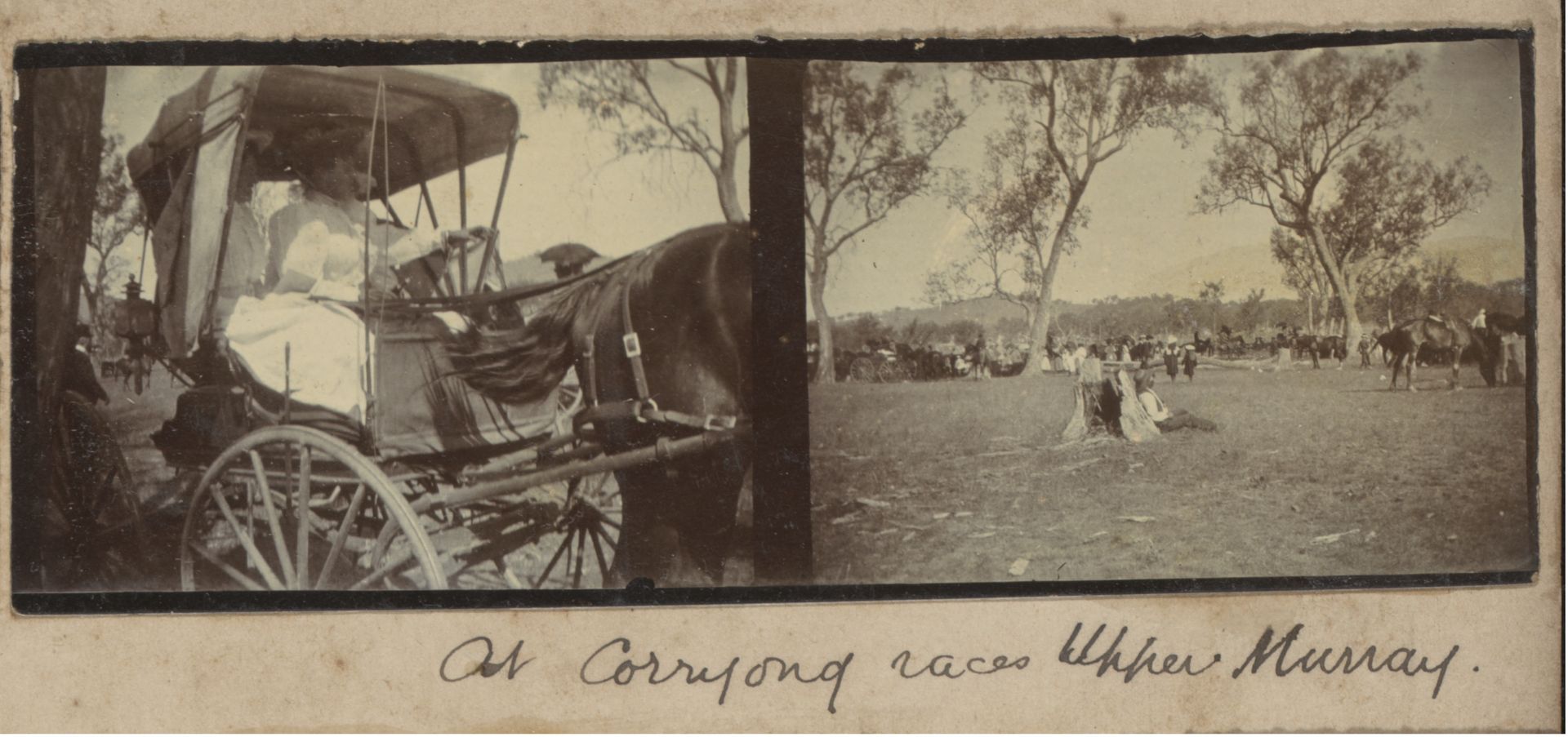
Photograph from Banjo Paterson’s album, (Source: The Papers of Andrew Barton ‘Banjo’ Paterson 1807-1950 NLA MS10483/ 10/30/38
Clancy of the Overflow
As Kiley’s Run is located roughly 32km east of Gundagai and 45km north of Tumut as the crow flies, horse thief Andy Regan had to cover some distance to escape the ‘troopers of Upper Murray side’!
Clancy of the Overflow is included in the collection of Paterson’s poems referencing the Upper Murray. In ‘The Man from Snowy River’ – ‘Clancy came down to lend a hand’:
Clancy of the Overflow
Clancy of the Overflow
I had written him a letter which I had, for want of better
Knowledge, sent to where I met him down the Lachlan, years ago,
He was shearing when I knew him, so I sent the letter to him,
Just "on spec", addressed as follows: "Clancy, of The Overflow".
And an answer came directed in a writing unexpected,
(And I think the same was written with a thumbnail dipped in tar)
'Twas his shearing mate who wrote it, and verbatim I will quote it:
"Clancy's gone to Queensland droving, and we don't know where he are."
****
In my wild erratic fancy visions come to me of Clancy
Gone a-droving "down the Cooper" where the Western drovers go;
As the stock are slowly stringing, Clancy rides behind them singing,
For the drover's life has pleasures that the townsfolk never know.
And the bush hath friends to meet him, and their kindly voices greet him
In the murmur of the breezes and the river on its bars,
And he sees the vision splendid of the sunlit plains extended,
And at night the wondrous glory of the everlasting stars.
I am sitting in my dingy little office, where a stingy
Ray of sunlight struggles feebly down between the houses tall,
And the foetid air and gritty of the dusty, dirty city
Through the open window floating, spreads its foulness over all.
And in place of lowing cattle, I can hear the fiendish rattle
Of the tramways and the buses making hurry down the street,
And the language uninviting of the gutter children fighting,
Comes fitfully and faintly through the ceaseless tramp of feet.
And the hurrying people daunt me, and their pallid faces haunt me
As they shoulder one another in their rush and nervous haste,
With their eager eyes and greedy, and their stunted forms and weedy,
For townsfolk have no time to grow, they have no time to waste.
And I somehow rather fancy that I'd like to change with Clancy,
Like to take a turn at droving where the seasons come and go,
While he faced the round eternal of the cashbook and the journal -
But I doubt he'd suit the office, Clancy, of "The Overflow".
The Bulletin, 21 December 1889.
The Men and their Mounts
'The Men and their Mounts' tells the story of the bush horses or brumbies and the stockmen who mustered and brought the horses down from the High Country and the bush-covered hills surrounding the Upper Murray before the First World War. The breeders of the Remounts and Walers often turned the young horses out into the bush to toughen them up and brought them back in as four-year-olds for sale to the Army buyers. The brumbies were often the bush horses that evaded muster to remain in the bush. Some of the bush horses or brumbies were kept as stock horses and on race days, stock horses often became race horses. In 1908, according to the Sydney Mail's article 'Visit to the Upper Murray', the writer Milroy remarked about that 'cattle experience makes them quiet, handy and hardy'.
The mural tells the story about the stockmen who became Light Horsemen and the bush horses that became the Remounts and Walers and continued to serve in the First World War. It is possible that Paterson witnessed or even took part in mustering of the Remounts and the bush horses and the experience became part of his inspiration for 'The Man from Snowy River'. During the First World War, Banjo Paterson served in the 2nd Remount Unit (Queensland and New South Wales) in Egypt where he trained and supplied horses to the Desert Mounted Corps and horses from the Remount Unit were also used as race horses on race days. With Angus and Robertson's pocket-sized anthologies of Paterson's poetry being poplar in the AIF serving on both the Western Front and in the Middle East, it is likely that Paterson knew that 'The Man from Snowy River' and some of his other poems were read and recited in the trenches and also in the Sinai and in Palestine.
Banjo Paterson, and his poem 'The Man from Snowy River' have a unique backstory in which the Upper Murray, Jack Riley, Tom Groggin and Kosciuszko have a well justified and proud place.'

Acknowledgements
The Upper Murray Historical Society wishes to acknowledge all of the above organisations for their support and thank the
National Library of Australia (NLA) together with
Mr Alistair Campbell for their assistance and their permission to use images from the
Papers of Andrew Barton ‘Banjo’ Paterson (MS 10483), NLA. For more information
click here.
History brought to life by
CalvertandCo.com
© Copyright protected 2026, Calvert & Co, Honor Auchinleck, and The Man From Snowy River Museum. All rights reserved.