
The Banjo Paterson High Country Trail
Wee Jasper, Coodravale and Hogan’s Gap
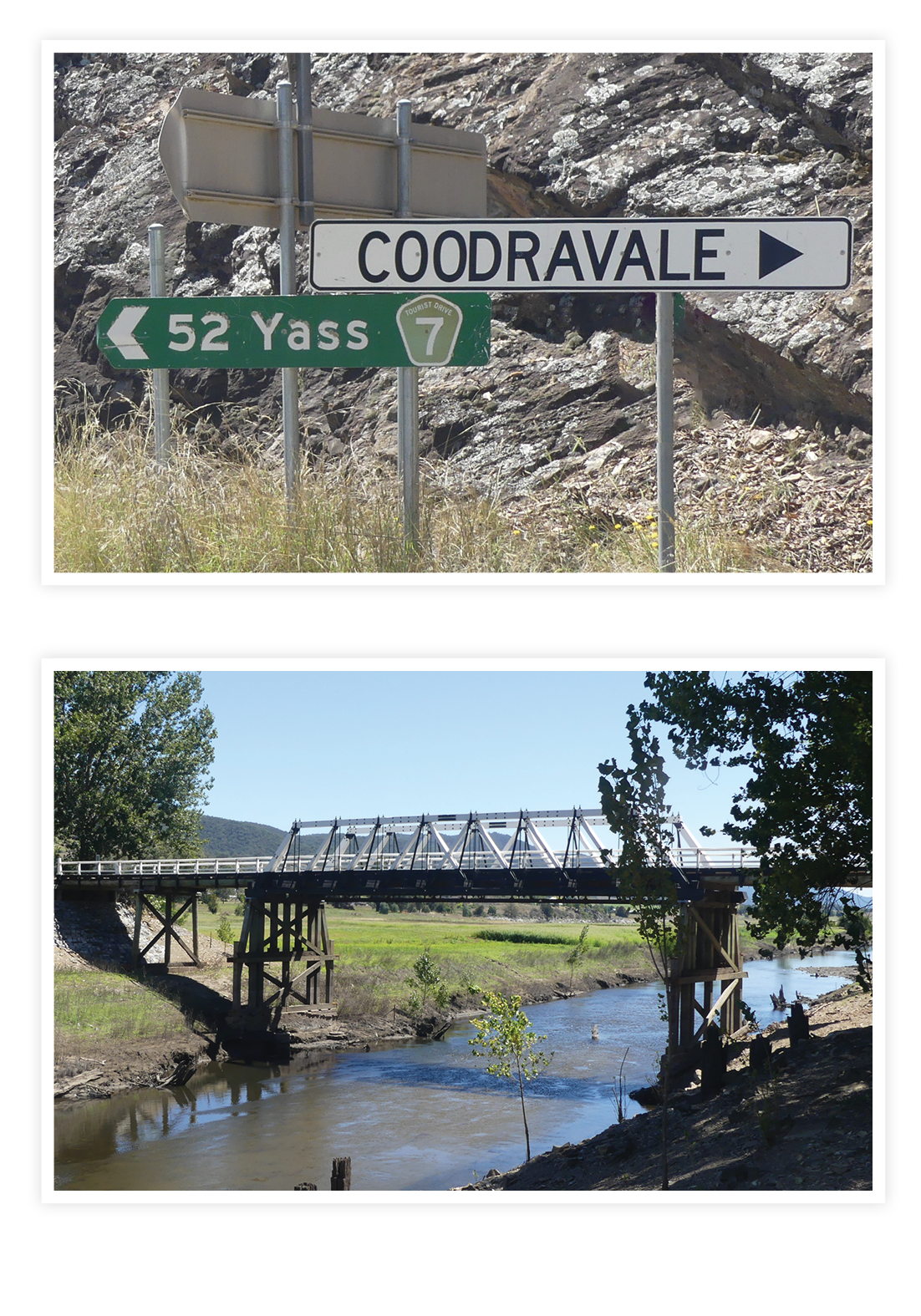
Between 1908 and 1911, Banjo Paterson lived and farmed at Coodravale on the banks of the Goodradigbee River near Wee Jasper.
The family had left Coodravale by the time Paterson penned ‘The Road to Hogan’s Gap. Coodravale is private property.
In his book Illalong Children, Paterson referred to the family property at Illalong, as ‘the family’s mountain station near Yass’. Even though Paterson published his poem ‘A Mountain Station’ in 1891 before he bought Coodravale, I have included it here as it reflects his knowledge of the Goodradigbee River’s upper reaches and the surrounding country, his experience and his aspirations. Paterson knew what he was taking on when he moved his family to Coodravale in 1908.
A Mountain Station
A Mountain Station
I bought a run a while ago,
On country rough and ridgy,
Where wallaroos and wombats grow –
The Upper Murrumbidgee.
The grass is rather scant, it's true,
But this a fair exchange is,
The sheep can see a lovely view
By climbing up the ranges.
And She-oak Flat's the station's name,
I'm not surprised at that, sirs:
The oaks were there before I came,
And I supplied the flat, sirs.
A man would wonder how it's done,
The stock so soon decreases –
They sometimes tumble off the run
And break themselves to pieces.
I've tried to make expenses meet,
But wasted all my labours,
The sheep the dingoes didn't eat
Were stolen by the neighbours.
They stole my pears – my native pears –
Those thrice-convicted felons,
And ravished from me unawares
My crop of paddy-melons.
And sometimes under sunny skies,
Without an explanation,
The Murrumbidgee used to rise
And overflow the station.
But this was caused (as now I know)
When summer sunshine glowing
Had melted all Kiandra's snow
And set the river going.
And in the news, perhaps you read:
`Stock passings. Puckawidgee,
Fat cattle: Seven hundred head
Swept down the Murrumbidgee;
Their destination's quite obscure,
But, somehow, there's a notion,
Unless the river falls, they're sure
To reach the Southern Ocean.'
So after that I'll give it best;
No more with Fate I'll battle.
I'll let the river take the rest,
For those were all my cattle.
And with one comprehensive curse
I close my brief narration,
And advertise it in my verse –
`For Sale! A Mountain Station.'
The Bulletin, 19 December 1891
The Road to Hogan's Gap
‘The Road to Hogan's Gap’ tells the story of a city official sent to deliver a letter to a settler named Hogan, but the official gives up because the route to Hogan's home in the mountains is too precipitous and circuitous. Hogan's Gap is a location in the rugged Brindabella mountains near Wee Jasper, named in the poem ‘The Road to Hogan's Gap’ by Banjo Paterson. Paterson, lived at the nearby Coodravale property from 1908-1911 and the dramatic landscape inspired him to write the poem. The location is known for its dramatic, mountainous terrain, though it is not a specific, named landmark today. The exact physical location of "Hogan's Gap" is not a current tourist site but is representative of the mountainous landscape in the region near Wee Jasper. (This information was provided by Rebecca Ormsby, Yass Visitor Information Centre.) Paterson wrote ‘The Road to Hogan’s Gap’ in 1914, the year the First World War broke out and Paterson’s and the world’s situation was changing rapidly.
The Road to Hogan’s Gap
The Road to Hogan’s Gap
Now look, y’ see, it's this way like —
Y’ cross the broken bridge
And run the crick down, till y’ strike
The second right-hand ridge.
The track is hard to see in parts,
But it’s still pretty clear;
There’s been two Injin hawkers’ carts
Along the road this year.
Well, run that right-hand ridge along,
It ain’t, to say, too steep.
There’s two fresh tracks might put y’ wrong
Where blokes went out with sheep.
But keep the crick upon your right,
And follow pretty straight
Along the spur, until y’ sight
A wire and sapling gate.
Well, that’s where Hogan’s old grey mare
Fell off and broke her back;
You’ll see her carcase layin’ there,
Jist down below the track.
And then you drop two mile, or three,
It’s pretty steep and blind;
You want to go and fall a tree
And tie it on behind.
And then you’ll pass a broken cart
Below a granite bluff;
And that is where you strike the part
They reckon pretty rough.
But by the time you’ve got that far
It’s either cure or kill,
So turn your horses round the spur
And face’ em up the hill.
For, look, if you should miss the slope
And get below the track,
You haven’t got the whitest hope
Of ever getting back.
An’ half way up you’ll see the hide
Of Hogan’s brindled bull;
Well, mind and keep the right-hand side,
The left’s too steep a pull.
And both the banks is full of cracks;
An’ just about at dark
You’ll see the last year’s bullock tracks
Where Hogan drew the bark.
The marks is old and pretty faint
And grown with scrub and such;
Of course the track to Hogan’s ain’t
A road that’s travelled much.
But turn and run the tracks along
For half a mile or more,
And then, of course, you can’t go wrong—
You’re right at Hogan’s door.
When you first come to Hogan’s gate
He mightn’t show, perhaps;
He’s pretty sure to plant and wait
To see it ain’t the traps.
I wouldn’t call it good enough
To let your horses out;
There’s some that’s pretty extra rough
Is livin’ round about.
It’s likely if your horses did
Get feedin’ near the track,
It’s goin’ to cost at least a quid
Or more to get them back.
So, if you find they’re off the place
It’s up to you to go
And flash a quid in Hogan’s face—
He’ll know the blokes that know.
But, listen, if you’re feelin’ dry,
Just see there’s no one near,
And go and wink the other eye
And ask for ginger beer.
The blokes that come in from near and far
To sample Hogan’s pop‘
They reckon once they breast the bar
They stay there till they drop.
On Sundays you can see them spread
Like flies around the tap.
It’s like that song “The Livin’ Dead”
Up there on Hogan’s Gap.
They like to make it pretty strong
Whenever there’s a charnce;
So when a stranger comes along
They always hold a dance.
There’s recitations, songs, and fights,
They do the thing a treat.
There’s one long bloke up there recites
As well as e’er you’d meet.
They’re lively blokes all right up there,
It’s never dull a day.
I’d go meself if I could spare
The time to get away.
****
The stranger turned his horses, quick,
He didn’t cross the bridge.
He didn’t go along the crick
To strike the second ridge.
He didn’t make the trip, because
He wasn’t feeling fit.
His business up at Hogan’s was
To serve him a writ.
He reckoned if he faced the pull
And climbed the rocky stair,
The next to come might find his hide
A landmark on the mountain side,
Along with Hogan’s brindled bull
And Hogan’s old grey mare.
The Lone Hand, 1914
The Mountain Squatter
During the First World War Paterson served in the 2nd Remount Depot (New South Wales and Queensland) in Heliopolis in Egypt. Paterson’s memories of Coodravale must have been on his mind in 1915 when he wrote about his ‘mountain home’ in his poem ‘The Mountain Squatter’.
The Mountain Squatter
The Mountain Squatter
ThHere in my mountain home,
On rugged hills and steep,
I sit and watch you come,
Oh Riverina Sheep!
You come from fertile plains
Where saltbush (sometimes) grows,
And flats that (when it rains)
Will blossom like the rose.
But when the summer sun
Gleams down like burnished brass
You have to leave your run
And hustle off for grass.
'Tis then that – forced to roam –
You come to where I keep,
Here in my mountain home,
A boarding-house for sheep.
Around me where I sit
The wary wombat goes,
A beast of little wit
But what he knows, he knows.
The very same remark
Applies to me also;
I don't give out a spark,
But what I know, I know.
My brain perhaps would show
No convolutions deep,
But anyhow I know
The way to handle sheep.
These Riverina cracks,
They do not care to ride
The half-inch hanging tracks
Along the mountain side.
Their horses shake with fear
When loosened boulders go,
With leaps, like startled deer,
Down to the gulfs below.
Their very dogs will shirk,
And drop their tails in fright
When asked to go and work
A mob that's out of sight.
My little collie pup
Works silently and wide;
You'll see her climbing up
Along the mountain side.
As silent as a fox
You'll see her come and go,
A shadow through the rocks
Where ash and messmate grow.
Then, lost to sight and sound
Behind some rugged steep,
She works her way around
And gathers up the sheep;
And working wide and shy,
She holds them rounded up.
The cash ain't coined to buy
That little collie pup.
And so I draw a screw
For self and dog and keep
To boundary ride for you,
Oh Riverina Sheep!
And when the autumn rain
Has made the herbage grow,
You travel off again,
And glad – no doubt – to go.
But some are left behind
Around the mountain's spread,
For those we cannot find
We put them down as dead.
But when we say adieu
And close the boarding job,
I always find a few
Fresh earmarks in my mob.
So what with those I sell,
And what with those I keep,
You pay me pretty well,
Oh Riverina Sheep!
It's up to me to shout
Before we say goodbye –
"Here's to a howlin' drought
All west of Gundagai!"
The Lone Hand, July 1915
The Lone Hand was a monthly literary magazine published between 1907 and 1928.



Acknowledgements
The Upper Murray Historical Society wishes to acknowledge all of the above organisations for their support and thank the
National Library of Australia (NLA) together with
Mr Alistair Campbell for their assistance and their permission to use images from the
Papers of Andrew Barton ‘Banjo’ Paterson (MS 10483), NLA. For more information
click here.
History brought to life by
CalvertandCo.com
© Copyright protected 2026, Calvert & Co, Honor Auchinleck, and The Man From Snowy River Museum. All rights reserved.